
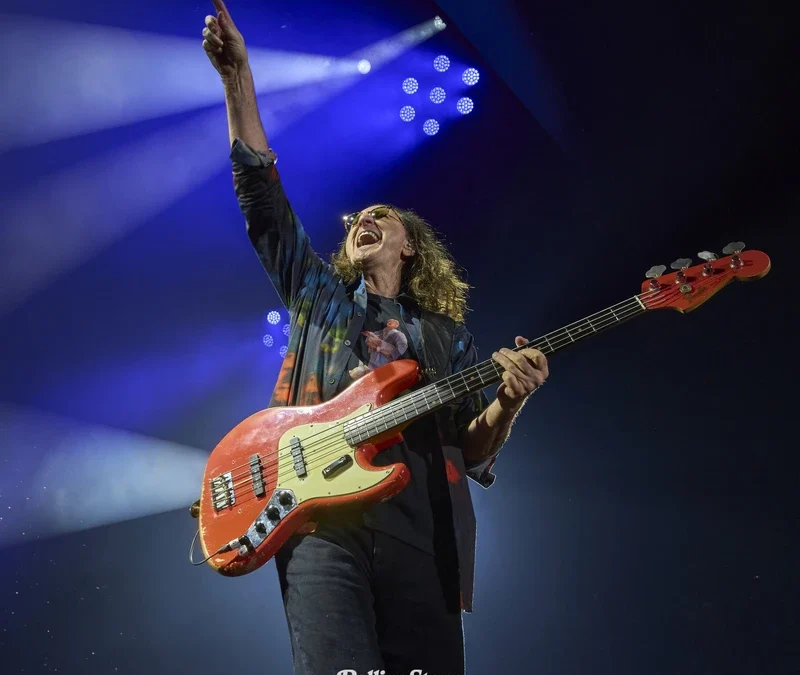
Geddy Lee: Photograph by Richard Sibbald for Rolling Stone Canada
Excerpt from Rolling Stone Article by By Brian Hiatt
Before rebuilding the band, Lee had to do the same for himself. “I didn’t play bass on a regular industrial level for 10 years,” he says. “I thought I was in shape, ’cause I would go down to the studio, and I would play one of my zillion basses, and I would go, ‘Ah, this is great bassing!’ You’d think you’re in shape. You’re not. That’s not playing shape. That’s not touring shape. Not until you get calluses on calluses on calluses and your fingers are sitting there at night sizzling. That’s getting in shape. So I had already made the decision before Al agreed to do any tour to get my fingers back in shape.”
His other task was scarier and more personal. How did the voice of Geddy Lee get so high? He had no idea, but he was finally going to have to find out. In the Seventies, Lee sang in a speaker-melting shriek that he unleashed without coaching or conscious technique, somehow doing everything right (or wrong, if you believed certain churlish critics) from pure instinct. From the Eighties onwards, he pared down the high notes, though he did push into glass-shattering territory on the final verse of “Freewill.” As the years passed, he found his old banshee wail harder and harder to access, particularly in this century. He took it as a natural part of aging, and simply did his best, occasionally lowering keys to give himself some help.
This time, after over five decades of singing professionally, Lee decided to take his first lessons. He began Zoom meetings with a veteran vocal coach, Mitch Seekins, who works remotely from the small town of Ilderton, Ontario. Seekins, a longtime Rush fan, knew right away that Lee was a long way from being ready. ” It was shocking,” says Seekins. “I mean, it was horribly out of shape. The muscles weren’t responding in the top end anymore.”
But the coach still had very good news for his client: “I could hear that it was there, he just couldn’t do it yet. He wasn’t sure if he was ever gonna be able to do what he did when he was much younger… But there was no degradation at all, even due to age.” The high notes would inevitably lack some of the reckless power of the old days, but they were all accessible. The real trick was convincing Lee that he could do it. ” The hardest part of the repair part is the psychological end of the thing,” says Seekins, whose techniques can seem Yoda-like. “Because it is subconscious, and if you’ve convinced yourself that you can’t do something, well, guess what? You can’t.”
Lee, who already works out four times a week, began to get it. ” It’s no different than going to the gym and getting strong,” he says. “You have to get this muscle strong, and that’s what I’ve worked on — and to take a more forensic look at how a voice makes a sound, and apply it.” Even so, he adds, “I was nervous to try some of those songs.”
It quickly became evident that he was pulling it off. ” We were just looking at each other like, ‘Holy crap,'” says longtime Rush collaborator Dale Heslip, who directed the tour’s opening film and designed the stage. “Like, he has turned back time.”
As Lee gained confidence, new possibilities opened up, including adding the long-unplayed title track of 1977’s A Farewell to Kings back to the show. It’s still the single hardest song of the tour for both Lee and Lifeson. Youthful ambition bequeathed them unpredictably shifting time signatures, a daunting nylon-string intro, some odd musical shifts during the guitar-solo section, and a long list of other complexities. “You kick off the verse, and I have to sing in this fucking stratosphere,” says Lee. “There’s a lot of insecurity that comes with bringing back a song from that long ago… When you’re at this age, people expect you to be a lesser version of yourself, and that’s just not acceptable to me.”
They did have the option of dropping keys down, which is how they handle 2112 and “Anthem,” on the grounds that they both sound heavier that way. “It’s partly an excuse and partly the truth,” Lee says. But they took a close look at “Freewill,” and decided to keep it as is. “There’s no way I would do that song unless I could hit that third verse,” says Lee. “Which is really the highest verse that I sing all night.”
Somehow, night after night, he’s making it all the way up there. “The cats,” says Lee, “are meowing.”
Read full article at Rolling Stone Canada