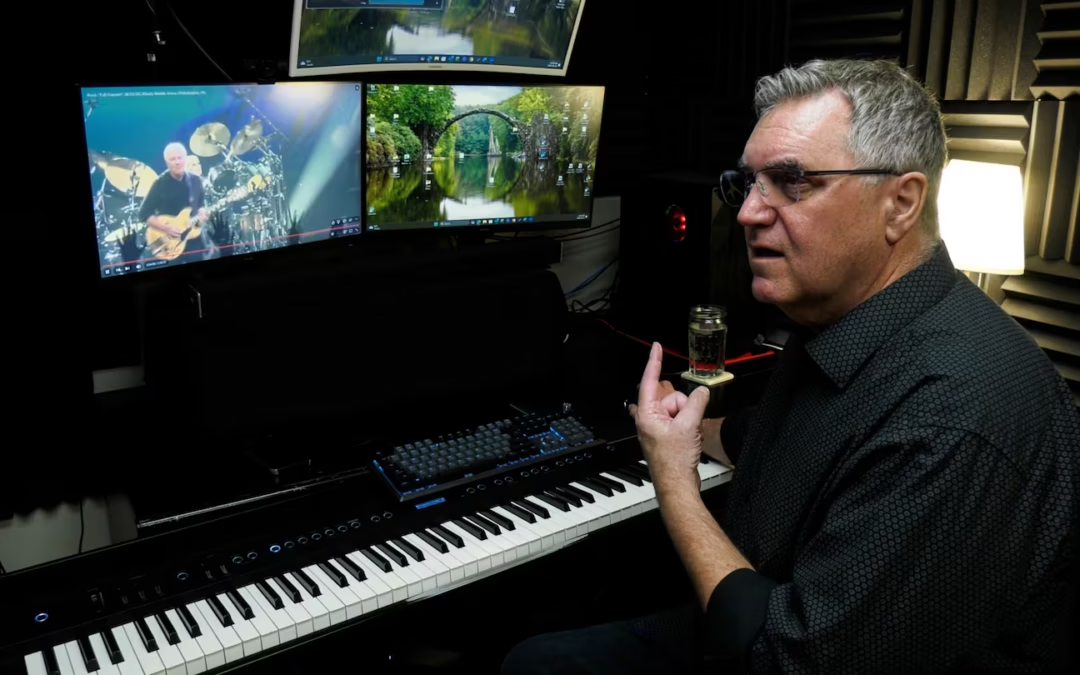
Vocal coach Mitch Seekins analyzes video of a Rush concert performance from his home studio in Ilderton, Ont. (Bryan Bicknell/CTV News London)
He has one of the most recognizable voices in Canadian music. But after 11 years away from performing regularly, Geddy Lee, of Rush, had to rediscover that voice.
“I found out, and it was a shock that I was his first vocal coach,” exclaimed Ilderton, Ont. based vocal coach Mitch Seekins.
“He never studied voice before. So, everything that he’s done has been completely natural up to that point, which is incredibly rare.”
A vocal coach for more than 35 years, Seekins was contacted in spring 2025 to help Lee prepare for Rush’s Fifty Something Tour. With Lee now in his 70s, Seekins knew the work would be demanding.
“The Rush repertoire in my mind has got to be the most difficult rock gig to sing because it’s so high, and it stays so high, the whole show. He rarely gets a break. So, does he have that in him anymore? What has the aging process done,” wondered the long-time voice expert.
Seekins worked with Lee nearly every day for four months, helping to build his voice to withstand the rigors of touring. The rock icon proved to be a highly disciplined student,” said Seekins.
“And he started to see the progress starting to happen, and things were coming back. And it was a lot of work. But thank goodness he’s focused, very focused,” he explained.
While Geddy Lee is his most notable, a who’s who of great talents can be found among Seekins’ roster of students, including Luke Bentham of Canadian rock band, The Dirty Nil.
“My imagination is kind of pushed to its limits kind of imagining what the rebuilding process would be like after taking such a sustained break as Geddy has. And it makes it all the more impressive when I watch the footage of them playing this tour that they’re on,” Bentham said.
Seekins has also taken on Rush guitarist Alex Lifeson as a student. Lifeson’s vocal role in Rush performances has historically been relatively minimal, but he wanted to expand his involvement for the current tour.
Full Interview
CTV News London’s Bryan Bicknell sat down with Mitch Seekins, who helped Geddy Lee of ‘Rush’ rediscover his voice in preparation for the ‘Fifty Something’ tour.
Geddy Lee: Photograph by Richard Sibbald for Rolling Stone Canada
Excerpt from Rolling Stone Article by By Brian Hiatt
Before rebuilding the band, Lee had to do the same for himself. “I didn’t play bass on a regular industrial level for 10 years,” he says. “I thought I was in shape, ’cause I would go down to the studio, and I would play one of my zillion basses, and I would go, ‘Ah, this is great bassing!’ You’d think you’re in shape. You’re not. That’s not playing shape. That’s not touring shape. Not until you get calluses on calluses on calluses and your fingers are sitting there at night sizzling. That’s getting in shape. So I had already made the decision before Al agreed to do any tour to get my fingers back in shape.”
His other task was scarier and more personal. How did the voice of Geddy Lee get so high? He had no idea, but he was finally going to have to find out. In the Seventies, Lee sang in a speaker-melting shriek that he unleashed without coaching or conscious technique, somehow doing everything right (or wrong, if you believed certain churlish critics) from pure instinct. From the Eighties onwards, he pared down the high notes, though he did push into glass-shattering territory on the final verse of “Freewill.” As the years passed, he found his old banshee wail harder and harder to access, particularly in this century. He took it as a natural part of aging, and simply did his best, occasionally lowering keys to give himself some help.
This time, after over five decades of singing professionally, Lee decided to take his first lessons. He began Zoom meetings with a veteran vocal coach, Mitch Seekins, who works remotely from the small town of Ilderton, Ontario. Seekins, a longtime Rush fan, knew right away that Lee was a long way from being ready. ” It was shocking,” says Seekins. “I mean, it was horribly out of shape. The muscles weren’t responding in the top end anymore.”
But the coach still had very good news for his client: “I could hear that it was there, he just couldn’t do it yet. He wasn’t sure if he was ever gonna be able to do what he did when he was much younger… But there was no degradation at all, even due to age.” The high notes would inevitably lack some of the reckless power of the old days, but they were all accessible. The real trick was convincing Lee that he could do it. ” The hardest part of the repair part is the psychological end of the thing,” says Seekins, whose techniques can seem Yoda-like. “Because it is subconscious, and if you’ve convinced yourself that you can’t do something, well, guess what? You can’t.”
Lee, who already works out four times a week, began to get it. ” It’s no different than going to the gym and getting strong,” he says. “You have to get this muscle strong, and that’s what I’ve worked on — and to take a more forensic look at how a voice makes a sound, and apply it.” Even so, he adds, “I was nervous to try some of those songs.”
It quickly became evident that he was pulling it off. ” We were just looking at each other like, ‘Holy crap,'” says longtime Rush collaborator Dale Heslip, who directed the tour’s opening film and designed the stage. “Like, he has turned back time.”
As Lee gained confidence, new possibilities opened up, including adding the long-unplayed title track of 1977’s A Farewell to Kings back to the show. It’s still the single hardest song of the tour for both Lee and Lifeson. Youthful ambition bequeathed them unpredictably shifting time signatures, a daunting nylon-string intro, some odd musical shifts during the guitar-solo section, and a long list of other complexities. “You kick off the verse, and I have to sing in this fucking stratosphere,” says Lee. “There’s a lot of insecurity that comes with bringing back a song from that long ago… When you’re at this age, people expect you to be a lesser version of yourself, and that’s just not acceptable to me.”
They did have the option of dropping keys down, which is how they handle 2112 and “Anthem,” on the grounds that they both sound heavier that way. “It’s partly an excuse and partly the truth,” Lee says. But they took a close look at “Freewill,” and decided to keep it as is. “There’s no way I would do that song unless I could hit that third verse,” says Lee. “Which is really the highest verse that I sing all night.”
Somehow, night after night, he’s making it all the way up there. “The cats,” says Lee, “are meowing.”
When people think about preparing for a concert tour, they often picture rehearsals, production meetings, long hours in the studio, and countless hours refining the music. What they don’t often consider is that the voice itself must be prepared just as carefully.
In fact, because the voice is a living instrument, preparing it often takes longer than prepping the music and show itself—particularly for veteran singers returning to the demands of touring after years away from the stage.
One of the greatest misconceptions about singing is that if someone could do it before, they should simply be able to do it again.
In reality, the voice doesn’t work that way.
Perhaps the best way to think about a professional vocalist is to think of them as a professional athlete.
No one expects an elite athlete to step away from competition for years and immediately perform at championship level without careful preparation. That would be ridiculous, and yet we often expect exactly that from singers.
Age, lifestyle, years away from regular performance, changes in health, physical conditioning, mindset, and confidence all influence how consistently a vocalist can perform. The goal isn’t to sound twenty-five again. The goal is to build a voice that is dependable, resilient, and capable of meeting today’s demands.
That distinction changes everything.
Beyond Vocal Exercises
One of the questions I’m asked most often is, “What are the best vocal exercises for preparing a singer for tour?”
The answer often surprises people.
Exercises are important but only one tool.
They are not the entire process.
Professional vocal preparation is about developing dependable habits that allow a singer to perform night after night under demanding conditions. Every rehearsal, every soundcheck, every interview, every travel day, and every performance places demands on the instrument.
The questions eventually become much bigger than, “Can you sing those notes?”
Instead, they become:
Can you sing them consistently?
How long does your vocal recovery take?
Are you confident you can do it again tomorrow?
Can you maintain that confidence when conditions aren’t ideal?
Those are the questions professional singers ask themselves.
Consistency Is the Real Goal
Throughout my career, I’ve worked with singers at every level—from developing artists to established professionals preparing for some of the most demanding performances of their careers.
What continually surprises people is that the biggest improvements rarely come from discovering a magical new exercise or technique.
Like any professional athlete, lasting improvement comes from developing consistency.
Consistency in breath management and support.
Consistency in vocal coordination.
Consistency in physical awareness.
Consistency in recovery.
When those elements begin working together, something remarkable happens. Range often improves naturally. Stamina increases. Uncertainty begins to fade, and confidence starts to take its place.
Confidence is never something that appears first.
It’s something that’s earned. It comes from trusting the process, putting in the work, and experiencing enough consistent success that confidence becomes the natural result—not the starting point.
The Psychological Side of Singing
This is probably one of the least discussed aspects of professional singing. Through the decades of being a vocal coach, I’ve learned that dealing with the psychological side can be one of the most challenging aspects of the job, but it has also become one of the most rewarding. One of the greatest rewards in my work is watching someone achieve something they had already convinced themselves was impossible. Often, the biggest obstacle isn’t the voice—it’s the belief that the voice can no longer do what it once could. Watching that shift happen—when uncertainty gives way to surprise, surprise turns into a sense of possibility, and that possibility begins to grow into confidence—is one of the most gratifying parts of what I do.
A singer who has experienced vocal inconsistency often begins anticipating problems before they happen. That anticipation creates tension. Tension interferes with coordination. Coordination changes how the voice responds.
And if a singer has experienced vocal damage or a series of highly disappointing performances, the psychological impact can run surprisingly deep.
I’ve had clients come for an initial session convinced they had permanently lost or damaged their voice, only to discover that the real issue wasn’t permanent damage at all. Sometimes it was accumulated fatigue. Sometimes unnecessary tension. Sometimes it was simply a loss of trust in what their voice was still capable of doing. While situations like that aren’t common, helping someone rebuild that trust is one of the most rewarding parts of what I do.
Rebuilding that trust doesn’t happen through positive thinking alone.
It comes from experiencing consistent success, one step at a time.
It also comes from learning not to fear the occasional difficult day. Every professional singer has them. The important skill is learning to recognize what’s happening, understand why it’s happening, and know how to respond before frustration takes over.
Confidence is rarely built by perfection. It’s built by understanding.
Every Voice Has a History
No two professional voices are the same. Every singer brings decades of habits, performances, successes, disappointments, injuries, recoveries, and personal experiences with them.
For that reason, there is rarely a one-size-fits-all solution.
Effective coaching begins by understanding where the voice is today—not where it used to be.
From there, the work becomes highly individual.
Sometimes it means rebuilding range.
Sometimes it means improving efficiency.
Sometimes it means restoring endurance.
Sometimes it means making subtle adjustments that dramatically reduce unnecessary effort.
Sometimes it means all of the above.
The common thread is always the same: building a voice that can meet the real-world demands placed upon it.
Lessons From the Highest Level
Over the past year, I had the privilege of working alongsideGeddy Lee and Alex Lifeson as they prepared for Rush’s Fifty Something Tour.
While every artist’s journey is unique, one thing stood out throughout the entire process.
Great artists aren’t searching for shortcuts.
They’re willing to trust the process.
They’re willing to be patient.
They’re willing to revisit—or sometimes learn—the fundamentals that many people assume they no longer need.
Professional artists understand something that often gets overlooked: excellence isn’t maintained by talent alone.
It requires discipline, continual refinement, thoughtful preparation, and genuine respect for the instrument.
Those principles apply whether you’re preparing for an arena tour or your first performance at a local venue.
The Takeaway
Whether you’re preparing for your first local performance or your hundredth arena show, the principles remain remarkably similar.
Build consistency before chasing extremes.
Develop endurance before relying on adrenaline.
Protect your voice—but don’t shelter it.
Like any athlete, a singer becomes stronger by challenging the instrument intelligently, not by avoiding difficult work. Growth isn’t always comfortable, but when training is thoughtful and controlled, discomfort often becomes part of developing strength rather than a sign that something is wrong.
Most importantly, don’t take your voice for granted.
Longevity isn’t an accident.
It’s the result of thousands of thoughtful decisions made over the course of a career.
There will always be good days, great days, and difficult days. That’s simply the reality of working with a living instrument. The goal has never been to sing perfectly every single time.
The goal is to build a voice you can rely on—today, tomorrow, and for years to come.
A Final Thought
Over the years I’ve learned that the voice rarely rewards impatience.
It responds to consistency.
It responds to intelligent training.
It responds to respect.
Whether you’re preparing for your first performance or returning to the world’s biggest stages, the principles remain remarkably similar.
The singers who enjoy the longest careers aren’t always the ones with the biggest range or the most natural talent.
They’re the ones who learn how to work with their voice instead of against it.
Transcript:
Hi, I’m Mitch Seekins, the vocal coach, and welcome to The Vocal Files.
Today, I’m talking with Brett Emmons, lead vocalist of The Glorious Sons. [Music]
Hailing from Kingston, Ontario, The Glorious Sons over their 12-year history has hit some pretty amazing milestones. To date, they’ve had 13 top 10 Canadian hits as well as two US number ones, and have two Rock Album of the Year Juno Awards. The group tours the world playing huge venues, and has even opened for the Rolling Stones three times. I talked to Brett about his journey and the trials and tribulations of being lead vocalist for one of Canada’s top rock acts. If you enjoy this, give me a thumbs up and follow for more.
Mr. Emmons, good morning. Good morning, how are you? I’m doing fine, how about you? I’m good. It’s bright and early on a Saturday morning, thanks for doing this. No problem, thanks for having me. Excellent. So I’m just going to kind of fire off some questions and just, you know, give me your thoughts and let me know how things work for you.
Yeah. Okay, so how old were you when you began this whole insane journey of making music and singing for a living?
When we started getting, I guess, relative success, I was 19 or 20. When you started getting relative success. But what was the build up to that? Like, how did you begin this whole thing? Did you start when you were a kid? Yeah, well, I started early and then quit for a while. Okay. Yeah, I started guitar lessons and I think I was just too young.
I was the kid who was always singing to himself in the bathtub in the shower and kind of wanted to be a superstar even when I was like nine years old. Yeah.
And I quit for a while just because I, you know, I think the focus wasn’t there. And then in high school, I was hanging out with this guy and basically said, you seem crazy enough to be a frontman.
And I said, all right, cool. And I joined this punk band and we started jamming in his friend’s basement.
Stuff like what’s that band called? The song is called Skulls, The Misfits. And I was kind of like exposed to all the music that I’d never really even knew existed. I was probably a great nine or ten and I was really a classic rock guy. Right. And anyways, long story short, that lasted for about two months and then they kicked me out of the band because I wasn’t a good enough singer.
And yeah, and I didn’t I like I started to like some more punk stuff, but mainly I am like a rock and roll guy. That’s I love the soul and the swing of rock and roll. And, you know, I love the voices, obviously. And so I started my own band with my best friend, Shane Doubleman, and a guy named Richard Storms, who is like a savant at this time. I’m telling you, he was like so fucking good at playing guitar in high school. It was he wasn’t just like good at playing other people’s songs. He was creating amazing riffs as a as a guy in high school. And Shane love John Bonham. So he like actually got pretty good at the kick pedal thing. And we started a rock and roll band. And I took I took the song We Kings by the Tragically Hip and my brother’s acoustic guitar and I played it probably.
I would say probably over 500 times until my voice until my voice sounded good to myself singing.
So OK, good. Because I’d sing it and it wouldn’t sound good. I wouldn’t know what I how to do it. And I just basically locked myself in my room and got slowly better and better and better and better at singing. And that was a song that I developed some kind of voice to as a kid. Yeah. And then we went to Battle of the Band and I got Beth Singer and we ended up beating them out and the band that kicked me out. And from there on, my journey was created and I was just addicted to it. Like after that, it all started with a little bit of spite and a little bit of, you know, I really wanted to prove I wanted to prove somebody wrong. And now me and the guy are still kind of good, not good buddies, but buddies. He hangs out with my best friend. Yeah. And I see Jordan who kicked me out of the band. I see him like, you know, six or seven times a year and we have drinks and hanging out. Well, I mean, you were kids and now you’re adults. And, you know, I mean, it was a lot the same for me. You know, don’t tell me I can’t do something. And then I mean, I got I got addicted to it like at an early age as well. Like it was just it was just such a yearning for me to do that. Yeah. And it seems like the same thing for you and for a number of other people that have interviewed. There’s that thing. There’s that urge to do that. So like in the beginning, so you were kind of doing a punk thing. Was there anybody in particular that was like a real influence vocally for you? None of that punk stuff really influenced me vocally. Like it didn’t hit me enough to really want to like emulate Johnny Rotten or something like that. No. No. That’s the thing is, I think even I couldn’t sing it necessarily because I was trying to emulate it. But there was no soul attached to what I was trying to do. So really the stuff that actually the people that I when I joined started a rock and roll band, the people that really kind of kicked me into gear was Lane Staley. I would put on Alton Chains and try to get my voice as heavy and as strong as his. And I’d sing I’d sing the rooster and I could never quite get it, but I would just scream it as hard as I could. And that that helped me a lot. And I think that helped me develop a pretty strong voice.
I think also you get used to the pain, like because I wasn’t singing properly, but you get used to a certain amount of pain that that’s you can then withhold. Do more. It’s a shape thing. It’s like it’s an athletic thing. So you’re getting in shape. Yeah. The more you do, the more you can, whether it’s proper or not, there’s you still increase your endurance, your stamina, what you can do tonally, texturally.
Yeah. Yeah. Ronnie. Ronnie Van Zandt. Oh, yeah. Yeah. Who else? I mean, I was as a child, gigantically and ACDC. By this point, I wasn’t as, you know, trying to emulate Von Scott or Brian Johnston. But yeah, and a lot of soul like the guys that stole and scratching this in their voice, Bob Seger. Yeah. I just those are the voices that I always like, gravitate to. They were the ones that blew my mind, like how it made. I told my buddy once, like, singing to me is like measured pain. And that’s how I hear voices, too. It’s like when you can hear the pain in their in their in their singing. Like, not exactly throat pain, but, you know, soul, the soul. Yeah. Yeah. Absolutely. So now when you when you started, so you went from there and the glorious sons just kind of organically happened. Like you started writing songs or like that. How did that all come about? Well, there’s much more to it. So the dream for we were called Stone City Limits, that bands. Yeah. And our dream was to move to Toronto together and then after high school and just try it. But, you know, life ended up happening. You know, people stuck around town. Everybody went to different schools, whatnot. But Jay and I, my brother, would obviously Jay had a band as well. So Stone City Limits would open for him. Oh, yeah. And his band, the Sauce. And we played all these bars when we were like 16 and 17.
Me and Jay were always around each other playing music. Yeah. And our dream was always, you know, to be in a band together, too. Yeah. So then we started a band called the Stone Ponies and that was a kind of a rock thing. And we did about three or four songs, recorded them. And then we started a band called The Ranchers Together. And this was during summers or whatever. I was living with him and his buddy, Scott. I think me and my parents were fighting or something at the time, I forget. And what ended up happening was I went to school, introduced Jay to Adam, who was our drummer now. Yeah. Yeah. And they started jamming. And I would come home and I would hear how good they were. And at first they’re calling me to come join the band. And I’m like, yeah, fucking right. Like I’m out here on the East Coast. I’m hardly doing school. I’m trying to pursue music out there. Yeah. And I’m going I’m not I’m not going home like that’d be crazy. I wanted to do something on my own. Right. And I came home on Christmas and I heard them. I said, what the fuck is this? Like, what am I doing? Like, this is so much better than anything I’m doing. And I went back to school. I got into a little bit of trouble and I just called my brother and I said, hey, man, can is the option still open for me to come join the band? And he was like, yeah, I’ll get you a job. You can come work for me and we can start jamming. And I came home and started working for him as a contractor during the days. And we’d go and play gigs at night. And that’s how Stone or the Gloria’s son started. Wow. When the Gloria’s son started recording, like, was there I mean, your vocal sound, did it just kind of grow organically with the tunes that you were doing? It was just you in the studio? Or did you kind of think, okay, I don’t want to do that because that sounds like so and so. Like, how did you create your own sound like? Well, there were three singers in our band at first. Okay. And for me, I started kind of as a hype man in a way, like I’d be smashing a tambourine and I would do certain vocal parts of the song like that would stick out. Yeah. And I always had a voice that was balls to the walls. Like, right. I didn’t know how to temper anything. I couldn’t sing harmonies because I couldn’t pull back. Yeah.
Stuff like that. And basically, what happened was we just kind of decided with our producer, John A, when we went to record the first time that my voice was the most effective. And he and he basically told us like,
I’m not going to be the only singer. And wow. And that created some band problems, obviously. Yeah. And I was, at the time, too young to address any of it. I didn’t really didn’t want to have the conversations. And none of us really did want to talk about it. So we just went with the flow. And I ended up singing the album. And, you know, I think naturally, I was never like,
I’m a very.
The wrong word is good, but I was never a good singer in the sense I never had great range or control over anything, but I always had fun. Yeah. And I and and I always you could, like I said, hear the pain or the soul. Absolutely. Yeah. Yeah. In my voice. Yeah. And it just worked out in that sense. So that was the first album in it and first EP and in it and it did well for us pretty much right away. As far as developing a style, I think I developed that style ever since I was a kid, because I never knew how to do anything 50 percent. So I would just go to sing and it would come out as really thick, really loud.
Yeah. And gravelly. Yeah. Great. Then you guys started touring. Like tell me about your, you know, your experience vocally touring. So as soon as we started touring, any time that we would go and play like three or four shows in a week. Yeah. My voice had just started to just disappear and obviously that was a worry for me. So I went to this vocal coach named Molly in town here and she taught me actually how to breathe and support my voice properly. Yes.
And we beat it in the shape and it it was like probably a five month process before our first like real big tour across Canada. And I ended up going on tour and pretty much sounded great. But it took a lot of work because it would just disappear on me. And as soon as it started being real, it started to just disappear. And I think that’s kind of the journey of every vocalist. To be honest, you hear everybody’s story is kind of like that. Like, yeah, I think they reach a they reach a point in the road where their natural their natural instincts don’t actually help them anymore. Don’t save them anymore. Once you did some studying, it helped a lot and and you were able to sustain stuff. Yeah. Talk to me about, you know, vocal recovery, like how do you how do you how do you manage, you know, those issues from, you know, back then to now like what do you what do you do? Is that has anything changed? Well, it’s all I think age aging. Yeah. When I was 22, I wouldn’t have to do much for vocal recovery at all. I could I could stay out till six in the morning and get up and sing. And I mean, that’s kind of, I think, also a genetic thing. I don’t know. I don’t know. I just had a stronger voice maybe. Yeah. But that started to disappear probably around three or four years ago. And now it’s kind of I drink pretty much enough water to wake up basically twice in the night and pee.
And, you know, I basically I start doing little warm ups as soon as I wake up in the morning. Yeah.
You know, you got me on the air humidifier humidifiers. Yeah.
Yeah, I think like the main thing is just don’t use it too much, you know, but then we’ve talked about this our schedule to we will jam for an hour and a half at soundcheck and then do VIP and stuff. And you always kind of laugh at me and do that. You grimace. Exactly.
So it’s a it’s a bit of a moving target for me. But basically, when I’m doing it right, the vocal recovery is just a lack. Don’t you don’t use it as much. Yeah. Drink as much water as possible.
Yeah. Yeah. Yeah. Yeah. Yeah. Rest and, you know, you try to get as much rest as you can drink lots of water. And that’s not the working part. That’s almost the part where you know what I need to know when I’m going to do that. Yeah. Yeah. Yeah. Yeah. Rest and you know, you try to get as much rest as you can drink lots of water. And that’s not the working part. That’s almost the part where you need to know when not to work. Yes. Yeah. And that’s kind of more with the psychological thing. You have to get to know when not to fake yourself out. Yeah. I would even sing this the same song that’s down check to try to get my voice better for a song. Yeah. And what I’d end up doing is actually spiking myself out for the show. Yeah. So now I’ve realized when it’s day of show, don’t worry about that song that’s causing you a problem. Just go out there and sing it that night and have fun. And do less during sound check. Yeah. So that’s another thing. Yeah. I mean, I’ve only learned that over the last four or five months, I’d say. Yeah. Yeah. Because it is it is athletic. Right. So if you know, if you if you go and work out,
during a sound check, essentially, you know, work out vocally during the sound check, you’ve wasted all the energy that you need to, you know, have for the show. You know, there’s a time of recoup where you can recoup between sound check and showtime. But sometimes it’s just not enough. You know, if you’ve completely, you know, expended everything in the sound check. So I mean, sound check is not a workout. It’s a warm up and
you know, check things out and make sure, you know, you can hear everything in the room. And then I mean, you know what it’s like, you know, doing a sound check in a room, but then the room fills everything bloody changes anyway. Yeah. Yeah. It’s like, Oh my God.
How long does it take you like, what’s your preparation for, you know, recording or like going on a tour? So you know, you got something coming up. What do you what’s your regiment for that? Like, do you do you? What do you do? Well, we’re I’m learning to do a little bit less, like I said, you know, and be confident in myself. Yeah. But you still have to get vocally into that. But you still have to get vocally in shape. So like if you’ve had three months off between tours or, you know, the end of the album cycle, you finish the touring cycle, you’ve got three months off. If you’re going, you get a shape. If you’re going on a tour, if you’re going for me, if I’m going on a tour again, it’s like a good two weeks, like two weeks. Yeah. Yeah. But not overkill. Like it can’t be two weeks straight.
Because that happened this last tour, the first tour for the glory tour when it started. We’d lost a member and we did three weeks every day trying to learn these songs. And my voice down it’s pretty amazing a weekend. But after, you know, two more weeks of damage by the time I get on tour, I sing really well. The first three nights for the show. I remember it was the third show. I went to sing this high note and my voice just kind of disappeared. Right. And I knew, OK, here, here it comes. So and then I sing the rest of the set. And then by the fourth show, it was getting like it was going from being this big to like,
you know, this small. And then the only thing that we could do is I had to get some steroids, hold up in a hotel, cancel a show, drink a ton of water. Yeah. And it held up for the rest of the tour, but not in a way where it sounded like me. It sounded like I was hitting the notes. Yeah. But it was it was light, very light. Yeah. Was this before we started working together? Yeah. This is why we started working together.
OK. Right. Yeah.
Ah, yeah.
When here’s something slightly different. So when you when you when you’re writing tunes, how do you approach that? Do you approach it voice first or do you kind of get a structure and then figure out what you’re going to do vocally afterwards or does it just the whole thing just kind of morph as it as it develops?
In the studio and you know, from writing to the studio to the finished product. It depends because it generally it can happen any way, really. But it generally happens three ways either. I need to get something out lyrically. So I’m writing kind of like a fake poem. Yep. And then up, sit down and thinking about it. And the melody will come kind of with the guitar and then the other way is this is the most normal way is basically I just sit on this couch every evening for.
Anywhere from.
Two to sometimes 10 hours. Wow.
And I just sit there fiddling away with my guitar on something on a riff and.
As soon as something feels like it’s catching a little magic, I start to, you know, explore that, explore that crack. And that’s generally the way it does. And then the other way is if I’m walking or fishing or doing anything active, a lot of times I’m just singing, playing around with my voice. And then I’ll start to sing, you know, something in the air and then I’ll come home and put the guitar to it. But that stuff generally tends to be a little bit more soulful. Yeah. Your imagination is just going because it’s yeah, it’s spontaneous. It’s not thought out. There’s no limits to it either. There’s another thing, whereas if I’m sitting with the guitar, generally, that’s when you find more of the folky kind of stuff that I’m doing. And it’s harder for me to really muster up the courage to go high and hard. And I’m, you know, I’m slouched over on a couch. I probably have two or three glasses of wine in me. You know, had a little bit of a joint or something. So I’m like just sitting there chilling. So I like to really get up and do the thing is like, God damn it.
Yeah, I those are the three ways I would say. And then the other way is I guess there’s four in the sense that in the jam room when we’re all together with the band, with the band. But generally, I have a hard time coming up with melodies with so much going on around in my ears. Yeah. So it’s easier for me to work out a melody and a thought on my own. Yeah. And then bring it into the jam room afterwards and let it kind of organically grow from there. Yeah. Cool. So you’ve been you’ve been doing this for a lot of years now, like 10 10 years now. The glorious sons is 10 years. No, no, it’s more than that. What’s how old I’m like.
I was 19 and I’m 31 now. So 12 years. Yeah. Yeah. Yeah. In terms of, you know, studying voice, because I mean, that’s what we do. But, you know, any thoughts on studying voice and how it’s helped your craft, your ability.
What it actually is, it helps in a really in an unconscious manner, I think a lot of the times.
Because if you’re when we’re doing scales or whatnot, the first thing I noticed when we were working when we were doing scales and I was using my voice, you know, practicing with you to two times a week, sometimes three. What would happen was when I went to sit down on the guitar, I would go to notes that I wasn’t going to before. Yeah, because I’m hitting them and I’m using them before. So they become more, they become more natural. Yeah. For you. Yeah. And you’re not scared of them anymore. Yeah, it expands your instrument. What you’re what you can do. Yeah, yeah, exactly. And another thing is obviously singing high. And like, and not too high. That’s the other thing is giving yourself kind of more confidence in that mid range, which always I used to think of that mid range is high for me because it was powerful. Yeah. But I can actually sing way higher than that. Yeah. Yeah. And now after practicing, I’m realizing that mid range is actually the sweet spot where I can actually do things that, you know, my voice sounds like me and like nobody else. Yeah. And it’s allowed me to kind of shoot for that more in songs rather than just going for the big thing. Because now that I, once you get better at singing going for the big thing is higher than it was before. But it doesn’t mean it sounds that good. Oh, I know. I know. And that’s I tell everybody, just because you can sing those notes doesn’t mean you should. Yes, you know, exactly. And the thing is, but if you if you if you work on those notes, it makes everything below that. It makes everything below that sweeter and easier and easier and it sound with more control and, you know, and yeah, it is. It’s a sweet spot. Yeah.
Is there anything you know that we’ve particularly worked on that sound that that stands out as a game changer? Is it like blending or is it breathing? Is it support? Like what? What? The breathing, the breathing is huge. The breathing is really huge. And then the blending obviously is huge because and false that I think is probably actually the most important one because now I can sing harmonies when I’m in the studio. Yeah, even to myself and I can have control, control over these ranges that I thought that I would just have to basically belch out and see what happened. And now I now I feel like I can, you know, sing it confidently. And I don’t have to scream it. Yeah. Is another thing. Yeah.
Yeah. And like, again, it sounds less ugly. So that’s nice.
That’s always good. Yeah. Yeah. So do you have any personal tips that you want that you may want to share with any, you know, vocalists, whether they’re just starting out or or, you know, be gigging for a while, like any kind of nuggets of wisdom that you can go, well, this journey is, you know, that kind of thing. Anything you think of?
I think. I think you got to listen to your body and you can go online and look up a ton of stuff and they’ll tell you what’s good and bad for you. And, you know, basically, you can confuse the hell out of yourself as a singer. And I managed to do that in the worst way, probably four or five years ago. And it didn’t it didn’t stop till this year and singing became a relationship that I didn’t even like. I didn’t even like singing. I used to tell people I like to song, right? I like to perform. I hate singing. And it’s a real shame because I actually have a good, unique voice and I never I never let myself actually just I did let my youth let myself and I stopped letting myself just go explore and be me and make mistakes. Yeah. And I’d be worried if I eat cheese, I’d be worried if I didn’t if I drank too much water. Somebody told me if you’re drinking too much water, it does nothing for you. You know, you can go and confuse the shit out of yourself. And really, I think that for about three or four years that I didn’t allow myself to have fun. And now I’m just finding my voice again. So don’t confuse yourself. You know, do listen to your body. Do the things that you think you should to thing. Go get help. I would recommend everybody finding a teacher, a vocal coach. Don’t go to five of them like me. Don’t try five different teachers in a year. It’s the dumbest thing you can do because they’ll tell you all different things. Different things I know. So find somebody that you like. Yeah. And one thing that helped for me too as a male was finding a male vocal coach, too. Right. I don’t I don’t know necessarily why but I think we do maybe think different than females. So it is it is slightly different. Although what I teach women to do is actually sing like a guy. Okay. Sing like a tenor because that is how pop and rock and punk, you know, is done. The voice is different structurally. But, you know, the approach is the same. But and every teacher is different. You know, I teach what, you know, I know and I’ve learned over the years and tried over the years and I’ve been practicing over the years, you know, so but yeah, no, you’re right. The you know, the internet can be incredibly confusing. And if you do try five different teachers, man, you’re not gonna settle on anything, you know, that’s gonna stick with you. So like that. So just have fun. Yeah, mainly and, you know, practice. But don’t kill yourself about it because really people just want to hear you be yourself. And that’s right. They don’t they don’t they don’t think of the athletics of what you’re doing. They don’t think of they just want to see somebody go on the stage, be themselves and, you know, have fun. That’s always what’s translated. It’s never changed. Ever since popular music has started. That’s what’s translated. Yeah, yeah.
Okay, for the tech guys out there, like, do you have a preference for a microphone that you use in on the road or like on stage or versus studio or do you just kind of, I’m gonna, I’m gonna tell you what I tell people all the time. Wrong, wrong guy.
I got I got Peter in the band helped with that sound guys. Brendan, Brendan JB, who was our sound guy before they got me on to stuff that they think is best. And I stay the hell out of it. I don’t I don’t ever. Perfect. Yeah, perfect. Because I mean, that’s really not your job. But some guys do have a preference and I like the phone, you know, but sometimes I wish I had more of an knowledge about it. But anytime I started to do a microphone, I started to think about it.
I started thinking about the technical things, my brain starts to get overloaded. And any of the creative thing just starts going like this and getting squashed, which is which is your job. The creative side is your job. I tried. I tried getting logic during COVID. Oh, yeah. I was gonna record myself and learn how to do all this stuff. It was a big dream and stuff. And I must have did the same acoustic track take like over 100 times. And I switch up the strumming a different way. And all this stuff like, oh my god, like, have I been strumming it wrong? And then it’s like, it literally all it does is just my brain just starts going like this and it confuses the shit out. I mean, by the end of it, I can’t even I can’t even I can’t just turn if what I had was actually ever good in the first place or anything because I yeah, yeah, I had the same experience. It’s just ended up twisting knobs way too much and not singing, which is what I wanted to do. It’s like, Oh my god. I was like, somebody to do that. You know, like when you learn the power of reverb for the first time in a duty and you want everything to sound like it’s in a canyon. Yeah, I know. I know. Well, thank you so much for doing this man. I really appreciate it. That was awesome. Awesome. Yeah. Thanks, man. And looking forward to the next record and the next tour. I’m seeing you this summer. That’s gonna be great. Thank you very much, man. Thank you, Mitch. All right.
Transcription:
The Glory Tour, when it started, we did three weeks every day. And my voice sounded freaking amazing a But after two more weeks of damage by the time I get on a tour, I sang really well. The third show, I went to sing this high note and my voice was kind of disappeared. Right. And I knew, okay, here it comes. And then by the fourth show, it was getting like, it was going from being this big to like, kind of this small. The only thing that we could do is I had to get some steroids, hold up in a hotel, cancel a show, drink a ton of water. Yeah. And it held up for the rest of the tour, but not in a way where it sounded like me. Was this before we started working together? Yeah, this is why we started working together. This is why we started working. Okay. Right.
Transcription:
After touring with the Dirty Nil for so many years, what do you know now with all that experience that you didn’t know when you started? If I warm up properly and if I am conservative with my voice in terms of the show and know the moments where I have to kind of give it and when I can, when I can afford to back off because we all can, right? Like you don’t have to, I think there’s this false mentality that like every single time has to be like the best. If you’re singing in a very intense style, I think you have to make some trade off. If you’re going to do a big tour and working together, like nobody notices like if, or if they do notice like that you didn’t go for that one big thing in that one song. They’re like, huh. And then it’s the next part of the song and their attention’s on that. So a lot of it is just being easier on yourself and recognizing that the lead vocal is an important part in a rock show. Of course, it’s much more about a communal experience and the vibe in the room. And if you can focus your energy on trying to make that really good, then any shortcomings in your voice will be swept under the rug and kind of the, it’s all part of the total package of this communion that we’re having together in the church of rock and roll. So don’t worry about the one part of it, even though it is an important part.